
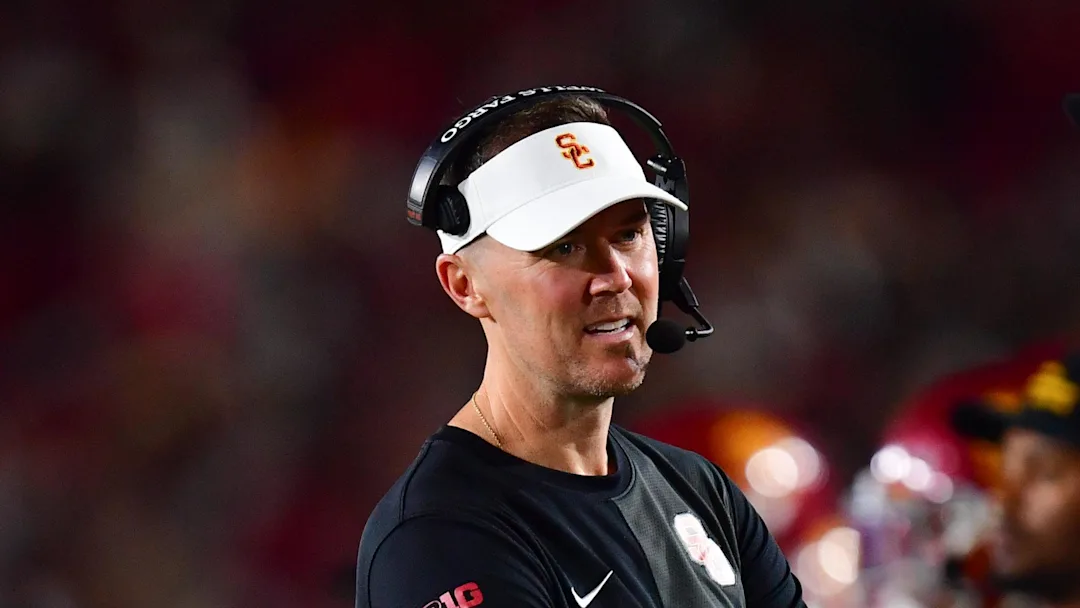
Matt Leinart: USC Heading in the Right Direction After Meeting With Lincoln Riley
LOS ANGELES – In the pressure-filled world of college football, where reputations are shaped by rivalry showdowns and postseason dreams, few opinions carry as much influence as Matt Leinart’s. The former 2004 Heisman Trophy winner and face of USC’s dominant early-2000s era — when the Trojans captured national titles in 2003 and 2004 — has never stopped caring deeply about his alma mater. But like many fans, Leinart has felt the frustration of watching USC lose its footing.
Under head coach Lincoln Riley, USC has endured a sharp downturn over the past three seasons. What was once seen as a program-reviving hire has turned into a challenging reality, especially with the Trojans now battling week after week in the unforgiving Big Ten. That decline bottomed out with a 7–6 record in 2024 and a Holiday Bowl appearance that felt more like consolation than celebration. Five of those losses came by one score, including a crushing overtime defeat to Penn State, leaving many questioning the team’s mentality.
Once thrilled by Riley’s 11–3 debut in 2022, the fanbase grew restless. Talk of Riley being on the hot seat grew louder, especially with the school investing heavily in NIL collectives and transfer portal acquisitions. Amid the criticism, Leinart chose a different path. Rather than pile on, he sat down privately with Riley for a deep and honest conversation — one he later described as “eye-opening.”
After that meeting, Leinart came away encouraged.
“We’re moving in the right direction,” he said this week — words that landed with hope among USC supporters desperate for a shift in momentum.
This wasn’t a media stunt or publicity moment. It was a private discussion away from the spotlight, rooted in mutual respect built over years. Leinart has known Riley dating back to the coach’s Oklahoma days, where his offensive mind made the Sooners perennial contenders. But this time, Leinart didn’t hold back. He came to understand what had gone wrong — and what was being fixed.
“Lincoln isn’t dodging anything,” Leinart explained. “He’s owning the close losses, the late fades, the missed chances. And the fire is still there. This team wants to win at the highest level.”
To appreciate the importance of Leipart’s confidence, you have to look back at USC’s glory days under Pete Carroll. From 2003 to 2005, the Trojans were college football’s gold standard, riding a 34-game win streak and collecting national titles, Heisman trophies, and future NFL stars. But the landscape has changed dramatically since then.
USC’s move to the Big Ten, the NIL era, and the chaos of the transfer portal have reshaped the sport. Riley inherited a program full of potential, but also instability, roster turnover, and growing pressure. While the 2022 season looked promising, the follow-up years — including an 8–5 campaign and then 7–6 — exposed deeper issues, especially on defense and in late-game execution.
Even Leinart himself acknowledged the pressure earlier in 2025, bluntly calling Riley “on the hot seat” during Big Ten Media Days. But he also defended Riley, noting how much harder program-building has become in the NIL and portal era. “You’re not just building anymore,” Leinart said. “You’re protecting your roster every day.”
USC entered the 2025 season unranked, with modest expectations and skepticism from oddsmakers. Still, signs of progress are emerging. Riley aggressively attacked the transfer portal, bringing in UNLV quarterback Jayden Maiava, a versatile dual-threat passer that Leinart believes could thrive in year two of the system.
“Jayden’s got the mindset for this,” Leinart said. “He’s humble, he understands the pressure, and he fits what Lincoln wants to do.”
Defensively, new coordinator D’Anton Lynn has begun reshaping a unit that struggled badly last season. With high-impact transfers like Anthony Lucas and Charles Woods, USC is building toughness and discipline on that side of the ball — two things that were sorely missing.
But beyond schemes and personnel, Leinart believes the true change is mental.
“We talked a lot about finishing games,” he explained. “You don’t lose five one-score games because of talent. That’s mindset. Lincoln is drilling fourth-quarter execution and mental strength. The players are buying in.”
The 2025 schedule will quickly reveal how real this progress is. USC opens against Missouri State before facing major tests against Notre Dame, Wisconsin, Michigan, Oregon, and Penn State. According to Leinart, a strong showing in those matchups could put USC back in national relevance.
“Beat Notre Dame, steal a couple against the Big Ten heavyweights, and suddenly you’re talking about a nine-win season and playoff conversations,” he said.
Off the field, Leinart remains deeply connected to USC. As a Fox Sports analyst, he continues to call Trojans games while mentoring players and participating in community projects. From quarterback clinics to fundraising events and even pickleball sessions with current players, he stays closely involved in the program’s culture.
Some critics will inevitably label his optimism as bias, but measurable improvements back it up. Advanced metrics predict USC’s defense will improve significantly, especially in red-zone efficiency. Offensively, Maiava’s efficiency and accuracy fit Riley’s system well, and USC’s future recruiting pipeline remains strong, highlighted by five-star QB commitment Husan Longstreet for 2026.
As Leinart reflected on his own playing career, he compared this moment to USC’s turning point after a loss to Kansas State in 2003 — a defeat that sparked one of the greatest runs in college football history.
“This talk wasn’t about blame,” he said. “It was about belief.”
USC’s road back to national dominance won’t happen overnight. The Big Ten is stacked with powerhouses like Oregon, Ohio State, and Penn State. But in Leinart’s eyes, the Trojans at least have their direction again.
And in a sport where pressure can destroy or define coaches, Lincoln Riley now faces it with renewed purpose — backed by one of USC’s greatest legends.
USC isn’t chasing redemption yet.
They’re rebuilding the path toward it — one step, one game, and one belief at a time.