
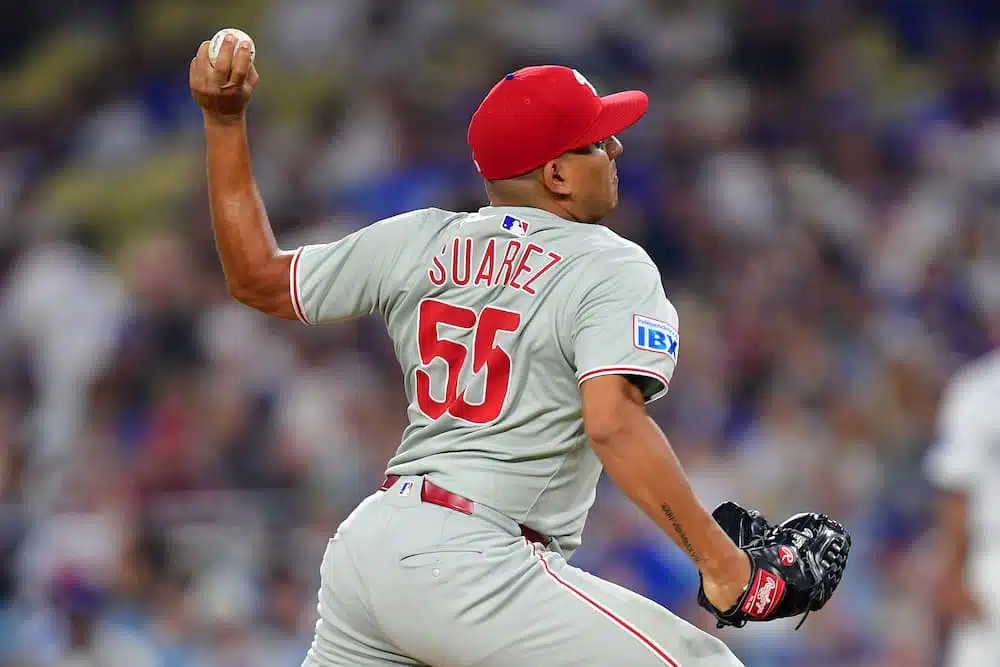
Ranger Suárez Declines 3-Year, $75M Deal; Warns Phillies That Without a New Contract, He May Retire
Philadelphia, PA – In a stunning development that has sent shockwaves through the Philadelphia Phillies organization and its passionate fanbase, left-handed starter Ranger Suárez has rejected a three-year, $75 million contract extension offered by the club earlier this offseason. Sources close to the situation confirmed on Tuesday that the 30-year-old Venezuelan not only turned down what would have been the richest contract ever handed to a Phillies pitcher with his service time, but also delivered a sobering message to the front office: if the two sides cannot reach an agreement on a deal that reflects his current market value and long-term security, he is seriously considering retirement at the end of the 2026 season—or possibly sooner.
The news, first reported by multiple outlets including The Athletic and MLB Network’s Jon Heyman, caught even the most plugged-in members of the Phillies beat by surprise. Suárez, who does not turn 31 until August and is coming off back-to-back All-Star caliber seasons, had long been viewed as a cornerstone of Philadelphia’s rotation alongside Zack Wheeler and Aaron Nola. The rejection of a contract that would have paid him $25 million annually through his age-33 campaign—guaranteeing him life-changing money with limited remaining team control—underscores just how dramatically the starting-pitcher market has shifted in the last 24 months and how confident Suárez and his representatives are in securing a far more lucrative payday.
According to league sources, Suárez’s camp is seeking a deal in the neighborhood of six years and $180–200 million, with some whispers suggesting they would listen to five-year offers north of $150 million. That range would place Suárez in the same financial stratosphere as recent mega-extensions handed out to pitchers such as Corbin Burnes (6 years, $210M with Milwaukee and Baltimore), Max Fried (8 years, $218M with the Braves before being traded), and the record-setting contracts of Yoshinobu Yamamoto and Blake Snell. While Suárez’s career numbers do not yet match the pedigree of those names on paper, his performance since the start of 2023—when he fully emerged as a frontline starter—has been elite: a 2.88 ERA, 3.18 FIP, 9.3 K/9, and 20.8 WAR (per FanGraphs) over 399 innings, numbers that rank among the top ten starters in baseball in that span.
The most jarring element of the standoff, however, is Suárez’s willingness to float retirement as a legitimate option. People familiar with the pitcher’s thinking say the threat is not merely posturing. Suárez, who has spoken openly about the physical toll the last few seasons have taken—particularly the back and oblique issues that cost him chunks of 2024—has told confidants that he has no interest in grinding through his age-31 through age-35 seasons on short-term deals or while constantly worrying about the next injury. Having already earned roughly $15 million in his career and with generational wealth now within reach, Suárez is said to be at peace with walking away if the Phillies are unwilling to meet his asking price.
One source inside the Phillies organization described the mood in Clearwater as “shell-shocked but not panicked—yet.” President of Baseball Operations Dave Dombrowski, who has never been shy about spending owner John Middleton’s money when he believes in a player, now faces an extraordinarily difficult decision. Committing $30–35 million per season to a pitcher who has thrown just 399 innings over the last three years and has a history of back issues is an enormous risk, even for a club with Philadelphia’s payroll flexibility. On the other hand, letting Suárez walk for nothing after the 2026 season—when he will still be on the right side of 32—would be a catastrophic loss for a team that views itself as a World Series contender for the next half-decade.
The timing could not be worse for the Phillies. With Wheeler turning 36 in May and Nola already 32, the rotation’s long-term outlook hinges heavily on younger arms like Suárez, Jesús Luzardo (acquired last winter), and prospects Andrew Painter and Mick Abel. Losing Suárez without compensation would leave a gaping hole and force Dombrowski into an already thin starting-pitcher market next offseason, where the top available names project to be Burnes, Fried (if his option is declined), and little else of Suárez’s caliber.
For now, both sides are maintaining a public stance of mutual respect. Suárez, speaking briefly to reporters at a charity event in South Philadelphia on Tuesday evening, refused to criticize the organization that signed him as a 16-year-old out of Venezuela in 2012.
“I love Philadelphia. This is my home,” Suárez said through a translator. “I want to be here. But I also have to think about my family, my future, my body. We’re talking, and I hope we find something that makes sense for everyone.”
When pressed on the retirement comments, Suárez offered a small smile and said only, “I’m not going to pitch forever. Nobody does. I just want to be treated fairly for what I’ve done the last three years.”
Phillies fans, already on edge after watching Bryce Harper and Trea Turner age into their 30s and the bullpen implode in October, flooded social media with a mix of panic and indignation. “Pay the man!” became the rallying cry on X, while others argued that $25 million a year for a pitcher with one truly great season (2022) and two very good ones was already an overpay.
Behind the scenes, the Suárez camp appears to be betting that another dominant first half in 2025—especially if paired with a deep Phillies postseason run—will make their asking price look conservative in retrospect. They point to the contracts signed by pitchers like José Berríos (7 years, $131M after a similar breakout) and Kevin Gausman (5 years, $110M) as recent comparables that now look like bargains.
For Dombrowski and Middleton, the clock is ticking. Suárez is under team control for two more seasons (roughly $15–18 million total via arbitration), giving Philadelphia leverage that most teams do not enjoy. But leverage cuts both ways, and Suárez has now made it clear he is willing to wield the ultimate trump card: walking away from the game entirely rather than settle.
As one veteran NL executive put it Tuesday night, “This isn’t your typical holdout. Ranger isn’t asking for the moon because he’s greedy. He’s asking for the moon because he knows he can get it—and if he can’t, he’s fine never pitching again. That’s a dangerous combination for Philly.”
Spring training is still ten weeks away, but the most important negotiation in the National League may have already begun. Whether it ends with Ranger Suárez signing the biggest contract in franchise history or retiring as one of the greatest “what-if” stories in recent Phillies lore remains to be seen. For now, Citizens Bank Park holds its collective breath.