
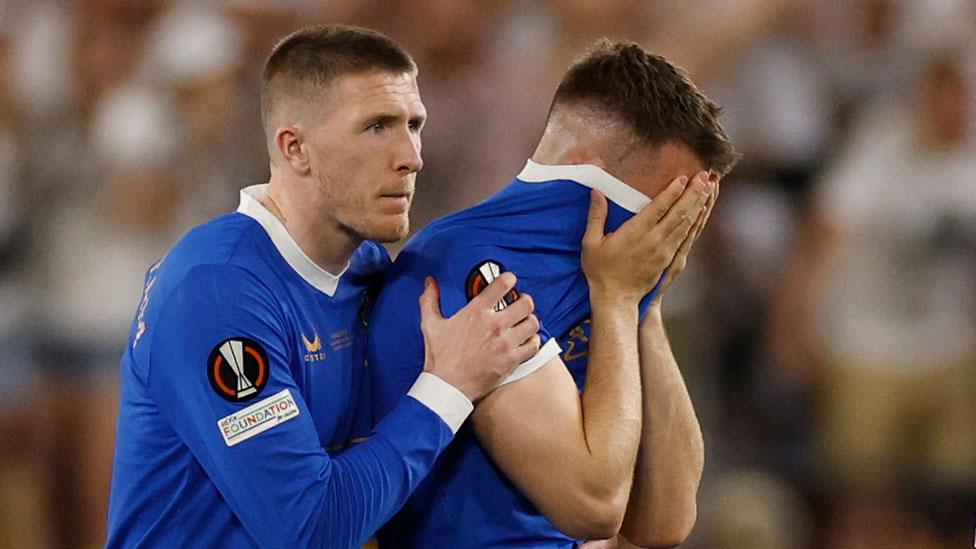
Rangers Save Themselves After Departure of Star Player
Ibrox Stadium, Glasgow – In a season that threatened to unravel before it had even reached Christmas, Rangers have somehow emerged stronger, more cohesive, and – whisper it – genuinely title-chasing following the £35 million summer departure of their talismanic captain and top scorer James Tavernier to Al-Ettifaq in the Saudi Pro League. What looked on paper like an irreplaceable loss has, against almost universal pre-season expectation, become the making of Philippe Clement’s rebuilt side.
Tavernier’s exit was seismic. Nine consecutive seasons as the club’s first-choice right-back, 124 goals from defence (a world record for a defender), armband welded to his bicep, penalties, free-kicks, last-minute winners – he was Rangers in human form. When the club accepted the life-changing money in July, the narrative wrote itself: another Scottish giant selling its crown jewels, another campaign doomed to play catch-up to Celtic. Most bookmakers slashed Rangers’ title odds from 7/4 to 11/2 overnight. Pundits queued up to declare the dressing room would be “leaderless” and the right flank “a gaping hole”.
Six months later, those same pundits are deleting tweets.
Rangers sit second in the Premiership, two points behind Celtic with a game in hand, unbeaten in twelve domestic matches, and fresh from a 4-0 dismantling of Hearts that had the Ibrox crowd singing Clement’s name louder than they ever sang Tavernier’s. The transformation has been as unexpected as it has been total.
The first and most obvious change is tactical. Tavernier’s bombarding overlaps and set-piece threat forced Clement into a lopsided 4-3-3 that often left the midfield exposed. Without him, the Belgian manager has shifted to a fluid 4-2-3-1 that morphs into a 3-4-3 in possession. Neraysho Kasanwirjo, the 22-year-old loanee from Feyenoord, has been the direct replacement at right-back and looks like he was born to wear the shirt. Quick, two-footed, positionally disciplined, and already contributing four assists, the Dutchman has brought balance rather than chaos.
But the real story is collective rather than individual. Tavernier’s departure removed the gravitational pull that had, perhaps unknowingly, made Rangers overly reliant on one man. Penalties are now shared (Dessers, Danilo, and even Ridvan Yılmaz have converted from twelve yards). Free-kicks over thirty yards are no longer automatic Tavernier territory; instead, the team works shorter routines that have produced seven goals this season already. Leadership has been dispersed: John Souttar wears the armband and has grown into the role, Connor Goldson snarls and organises like it’s 2021 again, and 20-year-old academy midfielder Bailey Rice has emerged as the dressing-room voice despite his tender years.
The numbers are startling. Last season, Rangers scored 27% of their league goals either directly from Tavernier or from moves he started on the right. This season that figure is down to 9%, yet total goals are up 18%. Expected goals (xG) against have dropped from 1.18 per game to 0.71. Rangers are no longer a team that wins because one player drags them over the line; they are a team that wins because the system suffocates opponents and multiple players step forward when needed.
Mohammed Diomande, the Ivorian midfielder signed in January but largely peripheral last term, is the poster boy for the new reality. Freed from having to constantly cover Tavernier’s forward runs, he is now averaging 9.4 progressive passes per 90 and has added four goals from distance already – shots that last season would have been waved away for the skipper to take. Similarly, Vaclav Černý on the right wing, signed as a direct creative replacement, has eight goals and six assists in all competitions, thriving in a system that finally trusts its wide players to stay high and wide rather than track back for an overlapping full-back.
Clement himself has been refreshingly blunt about the situation. “James was incredible for this club,” he said after the Hearts win, “but sometimes you have to lose something enormous to find out how strong the rest of the structure is. We are not a better team because James left – that would be disrespectful – but we are a different team, and right now that different team suits where we want to go.”
The board’s role cannot be ignored either. The £35 million from Tavernier’s sale was reinvested immediately and intelligently: Danilo permanently from Feyenoord, Černý from Wolfsburg, Kasanwirjo on loan with an option, and most crucially the contract extensions for Souttar, Jack Butland, and Tom Lawrence. For the first time in years, Rangers entered a season with genuine depth rather than a starting XI and prayer.
None of this is to diminish Tavernier’s legacy. The Englishman will forever be remembered as the man who scored the goal that stopped ten-in-a-row, who captained the club to 55, who broke goalscoring records that may never be beaten. But football moves relentlessly forward, and sometimes the kindest thing a legend can do for his boyhood club is leave at the right time with the right fee.
As Rangers prepare for the New Year Glasgow derby – a match they haven’t won at Parkhead since 2020 – the mood around Govan is unrecognisable from the grim fatalism of July. Fans who spent pre-season angrily waving “Back the Team” banners at directors’ boxes are now singing about “Philippe’s Blue and White Army”. The Tavernier banners still flutter on the Copland Road, but beside them now hang new ones: “Kasanwirjo 2”, “Rice 44”, “This is Our Team Now”.
Rangers didn’t just survive the departure of their star player. In a strange, almost poetic twist of fate, they may have saved themselves because of it.