
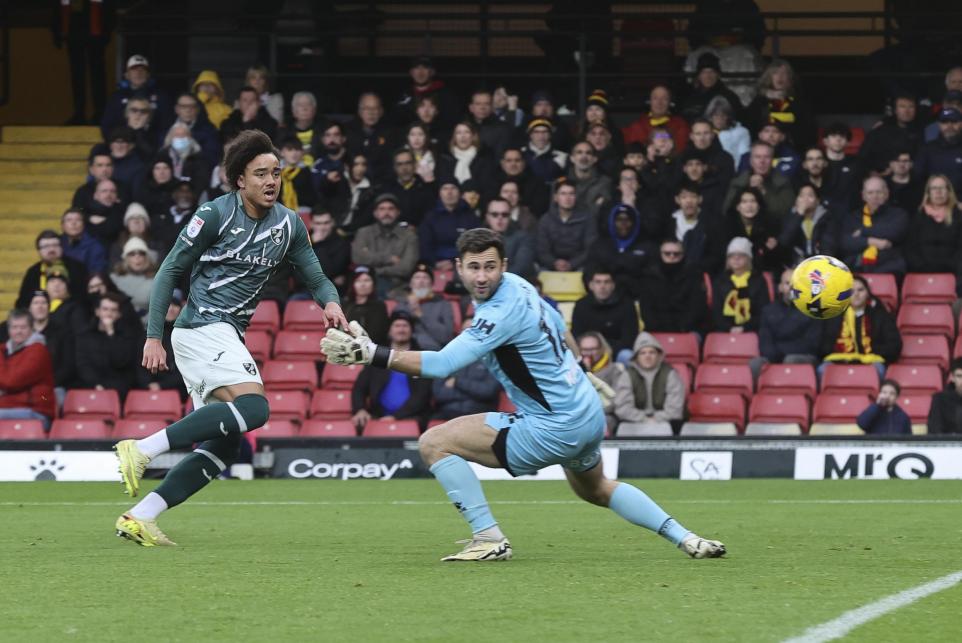
Norwich City’s inability to reassert authority after halftime—despite the momentum Watford had gained—and the shared defensive vulnerability both teams showed in transition moments led to a wide-open contest. Analyst Ben Lee breaks down the 3–2 Championship loss.
Ben, a long-time season-ticket holder and the creator of the NCFC Analysis platform, regularly dissects Norwich matches with detailed tactical breakdowns that highlight structural patterns, strengths, and shortcomings.
Here is his assessment of the chaotic encounter at Vicarage Road.
Watford vs Norwich: Hornets rally from behind
Final Score: 3–2
Possession (%): 54–46
Passes: 521–442
Shots: 13–15
xG: 1.28–1.88
Key Themes
· Shifting into a back three
· Pressing movements
· Watford’s adaptable build-up play
· Second-half tempo shift
Starting Structures
After finally ending their winless run, Philippe Clement took his Norwich side to Vicarage Road and made one alteration: Springett came in for Stacey in their familiar 4-2-3-1. Javi Gracia opted for two changes, bringing Kayembe and Chakvetadze into a 4-4-2 setup for the home side.
When Norwich began their deeper build-up sequences, they shaped themselves in their usual 4-2-3-1, with Mattsson (7) and McLean (23) forming the double pivot. Watford responded by initiating their press directly from their 4-4-2.
With McLean (23) prepared to drop into the defensive line to create a situational back three, Fisher (35) pushed forward to join the last line. Watford’s centre-forwards reacted with a pendulum-style press, alternating which attacker stepped forward while ensuring Mattsson (7) was blocked or occupied as the primary pivot option.
Whenever McLean (23) dropped toward the right centre-back zone, the Hornets’ left-sided winger pushed high to apply ball pressure, while their left-back advanced toward Fisher (35), forcing Norwich toward the touchline.
Yet City’s captain recycled possession across to Darling (6), who found himself completely free on the weak side of Watford’s pressure, leaving the home team’s right winger in an outnumbered 2v1.
From here, Clement’s side were able to progress into stable possession, with McLean (23) returning to the pivot line beside Mattsson (7), Fisher (35) joining the back of the attack as the fifth forward, and Forson (18) drifting inside into the right half-space.
Springett (42), meanwhile, usually remained deeper on the opposite flank, meaning Norwich often fell into their characteristic 2-3-5 structure while Watford retreated into a mid-block 4-4-2.
When Darling (6) fed Schwartau (29) on the flank, the wide man cut inside, prompting Springett (42) to surge around the outside. The youngster received the ball tight to the touchline after overlapping beyond him.
In another breakout, Norwich progressed in a similar pattern, though this time McLean (23) shifted again toward the right, drawing Watford’s left winger forward to press. The pressure, however, was half-hearted, allowing Norwich to pierce the line with a vertical pass into Forson (18), who spun away from his marker in the half-space before attempting a lofted through ball for Schwartau (29) making a run in behind.
During long spells of settled possession, McLean (23) frequently slotted next to the centre-backs to manufacture a temporary back three and create a 3v2 numerical superiority over Watford’s first pressing line. The hosts usually countered by having a winger step forward to prevent Norwich from progressing centrally and to funnel play out wide instead. On the right, this often led to Fisher (35) overlapping or underlapping around Forson (18).
In one different variation of Norwich’s possession shape, Springett (42) joined the last line, leaving Fisher (35) in a 2-3 rest-defence setup. To match this, Watford’s right winger dropped into the defensive line to form a momentary back five, preventing Norwich from gaining a 5v4 attacking overload.
Still, Gracia’s side generally tried to force Norwich back into earlier build-up phases by adopting an assertive mid-press from their 4-4-2. This typically caused McLean (23) to again retreat alongside the centre-backs as Norwich then attempted to target space behind Watford’s high line rather than becoming pinned deep.
In the opening half, though, the Hornets’ pressing—both mid-block and high—was not sharp enough. Their players repeatedly arrived late, failing to prevent Norwich from slicing through lines of pressure before combining quickly into half-spaces and releasing wide runners in behind.
Norwich’s second goal came directly from this weakness, with Clement’s team again exploiting the space beyond the defensive line. In one sequence, Watford’s front line applied almost no pressure, leaving McLean (23) completely unchallenged to clip a diagonal ball into the final third.
Sargent (9) received, dribbled inside, and fired a shot that was parried, allowing Marcondes (11) to pounce and feed Schwartau (29) at the far post for a 2–1 lead.
Watford, in their own deep build-up, opened with a double pivot of Louza (10) and Kayembe (39), while Norwich countered with a high 4-1-3-2 press, which saw Marcondes (11) join the front line and Mattsson (7) step forward to occupy space between Watford’s pivots.
On one occasion, however, McLean (23) retreated too early into a 4-4-2 shape and became caught out of position. This allowed Watford to escape down their right and find Kjerrumgaard (9), who dropped between lines to receive in a pocket of space.
Other than that moment, Norwich executed their first-phase pressing effectively, repeatedly hemming Watford against the flank and forcing long, inaccurate passes that Norwich’s defenders regularly swept up. Their pressing rhythm was clear: forwards closed from the front, Mattsson (7) locked onto the near-side pivot, the winger shut down the channel, and the full-back stepped up to seal the trap.
Outside of these deep build-up scenarios, Norwich shifted into a 4-4-2 pressing block, with Marcondes (11) staying forward and Mattsson (7) dropping next to McLean (23). With both central midfielders prepared to jump onto Watford’s double pivot, and the strikers applying front pressure, Kayembe (39) or Louza (10) occasionally drifted wide to receive beyond the initial press.
But Watford were too sluggish transitioning into their next attacking phase and repeatedly failed to deliver quality into their last line. Mattsson (7) again stood out, cutting out passes and launching counters where the hosts’ midfielders had vacated space.
Norwich’s defence also committed aggressively behind the press: full-backs stepped tightly to wingers, while the centre-backs followed Watford’s forwards when they dropped into midfield. In the build-up to Norwich’s opener, Darling (6) intercepted by tracking Kjerrumgaard (9) into the middle third.
Watford’s front four had licence to drift inside or drop off the line, but Norwich tracked these movements well and maintained the heat of their press, repeatedly forcing the Hornets into rushed long balls.
However, the second half told a different story. Watford significantly increased their pressing intensity, pushing closer to Norwich’s defensive line and denying them comfortable escapes. Their pivots also more frequently dropped into a back three during build-up, circulating possession far quicker than in the first half.
Louza (10), in particular, dropped regularly, helping to engineer a consistent 3v2 against Norwich’s frontline. This shift meant City could no longer generate turnovers as effectively as before.
Across the match, Norwich produced enough quality in possession, pressing, and chance creation—especially before halftime—to feel they merited more than a defeat.
But their inability to reclaim control after the interval, paired with both teams’ ongoing issues handling transitional moments, left the contest wide open. In the end, Watford capitalised on the chaos and edged the result.